The difference between being listened to and being understood, and what changes when you stop making the case
You tell them about the thing that happened at work. They say “mm.” They keep scrolling.
You bring up the same problem for the third time this month. They sigh before you finish the sentence.
You explain, carefully, why the way they spoke to you on Saturday hurt. They say “okay.” Nothing changes.
Sometimes they even repeat it back. They can tell you exactly what you said, and why you were upset. And you still walk away feeling like you were talking into a room with nobody in it.
That’s the part nobody warns you about. Being unheard doesn’t always look like not being listened to. Sometimes it looks like being listened to perfectly, and none of it counting for anything.
If any of this sounds familiar, the problem is probably not your partner’s ears. It’s something further in.
Hearing you and understanding you are two different events
The sentence “you never listen to me” is almost never about sound.
Most of the time the words arrived. Your partner could pass a quiz on them. What didn’t arrive is the part that would have made a difference: the sense that what you said landed on someone, and moved something in them.
Which is why “but I heard you, I repeated it back” is such an infuriating answer. It’s true, and it misses everything.
Listening is a transfer of information. Feeling heard is evidence that your inner life has weight with the person you chose. One is a task. The other is a relationship. A partner can complete the task perfectly and still leave you alone in the room.
Three failures hide inside the same complaint.
They didn’t hear you. Mechanically, they were elsewhere. The rarest version, the easiest to solve, and the one almost all advice is written for. Put the phone down. Pick a better moment. Fine.
They heard the content and missed the feeling. You said the thing about your sister. They responded to the logistics of your sister. The facts were received and the state you were in while saying them wasn’t. This is the everyday one, and it’s what most couples are actually fighting about when they fight about listening.
They heard the feeling and it frightened them. This is the one that hardens into a pattern. Your distress arrived, fully, and registered as a verdict on them. From there they aren’t listening. They’re defending. If that’s the shape of it in your house, Why Your Partner Gets Defensive covers what the defence is protecting.
Only the first is a listening problem.
What they’re doing instead of listening
Almost nobody is doing nothing. Something is happening in them while you speak, and it’s usually one of these.
Preparing. They started building the reply about eight words in. Everything after that gets skimmed for material.
Fixing. They convert what you said into a problem, because a problem has a solution and a solution has an exit. A feeling has no exit. It has to be sat with, and that’s harder.
Auditing. They’re checking your account for inaccuracies. Not out of malice. If one detail is wrong, the whole charge can be dismissed, and they very much want it dismissed.
Bracing. Heart rate up, thinking narrowed to a point, nothing getting in. They may look calm. They aren’t. When this becomes the default, it stops being a bad moment and starts being the silent treatment.
Translating. You said “I felt alone on Saturday.” They heard “you’re a bad partner.” That happens fast and below awareness, and afterwards they’re in a different conversation from you. One about their own worth.
None of these look like listening from the outside, and none of them are indifference. That matters, because indifference is what you’re most afraid of.
The escalation that makes listening harder
Here’s the cruel part.
Feeling unheard isn’t a neutral state you sit inside. It changes how you speak. And what it changes is precisely what makes you harder to hear.
You repeat yourself, because repetition is the only proof of delivery available to you.
You get louder. Or flatter, which is worse.
You reach for “always” and “never,” because a single instance can be explained away and a pattern can’t.
You bring evidence. Dates. Other times. What they said in March.
You pre-empt their defence, so the conversation opens with you accusing them of something they haven’t said yet.
Every one of those is a bid for reception, and every one of them raises the threat in the room. The harder you work to be heard, the more the conversation looks like a case, and a case requires a defence.
The loop is symmetrical. They feel prosecuted, so they protect. You feel unmet, so you push. If it’s turning every subject into the same subject, How to Stop Having the Same Fight Over and Over maps the shape of it.
Then comes the quiet phase, and it’s worse. You stop bringing things up, because the effort of not being met costs more than the thing was worth. From the outside, the fighting has stopped. The fighting stopping isn’t the same as the problem stopping.
What you’re actually asking for
Strip the argument back and the request underneath is small and specific.
Not agreement. You can be understood by someone who thinks you’re wrong.
Not a solution. You’d have asked for one.
Not even an apology, most of the time.
What you want is evidence that your experience registered as real, and that being real to them changed something. You’re asking to matter in a way you can see.
Saying that out loud is unreasonably hard, which is why almost nobody does it, and why so many of these conversations end up being about dishes.
What doesn’t work
Before the useful part, the honest part.
Explaining it better. If they already have the content, more content is more weight on a system already at capacity.
Telling them they never listen. True or not, it’s a sentence about their character, and character sentences get defended.
Waiting for them to work it out. Some people genuinely can’t read the difference between “I want you to fix this” and “I want you to know this.” Waiting to be read is a slow way to be disappointed.
Active listening drills. Worth naming, because it’s the standard advice everywhere else. Gottman found that the active listening exchange, as it’s taught to couples, almost never appeared when he watched couples actually argue, and that where it did appear it predicted nothing. Repeating your partner’s sentence back in your own words is a strange thing to do while upset, and most couples quietly abandon it.
What actually changes it
Almost every listening failure between two people who still care is a failure of genre. They didn’t know what kind of conversation they were in. So tell them, before the content.
Name the kind of listening you want, in one sentence, first. “I don’t need you to do anything about this. I need you to know it.” Said before the story it costs you nothing. Said afterwards it sounds like a complaint about their response.
Make it shorter. Counterintuitive, and it works. A long account isn’t more convincing, it’s harder to hold. People can only reflect back what they can carry. Give them one sentence with the feeling in it, and stop talking.
Ask for the reflection, not the agreement. “Can you tell me what you think I’m upset about?” isn’t a test, and shouldn’t be delivered as one. It surfaces the gap immediately, and the gap is rarely where either of you expected.
Let them say no with a time attached. “I want to hear this properly and I’ve got nothing left tonight. Tomorrow morning?” isn’t a refusal. It’s a refusal that names a return. A pause with a return time isn’t abandonment.
Ask what happens in them when you start. Not as an accusation. As a real question. Most people who go blank have never been asked what going blank feels like from the inside, and the answer is more interesting than the theory you’ve built about it.
When you’re the one being told you don’t listen
Maybe you’ve read this far recognising the other seat. You do listen. You can repeat it back. And it keeps not counting, and you’re tired of failing a test with no visible marking scheme.
Here’s the marking scheme.
Say back the feeling, not the facts. “That sounds lonely” does more work than a perfect summary of events. Facts prove attention. Feelings prove attention plus care, and the second one is what they came for.
You don’t have to agree in order to understand. This is the misunderstanding that makes people withhold understanding. “I can see why that landed badly” isn’t signing a confession.
Don’t lead with the correction. If a detail is wrong, it will still be wrong in ten minutes. Leading with it says their accuracy matters to you more than their state.
When it isn’t a listening problem
Some of this sits beyond a better sentence, and it would be dishonest not to say so.
If describing your own experience reliably ends with you being told your experience didn’t happen, that isn’t a listening problem, and it won’t be solved by explaining more clearly.
If the dismissal is contemptuous rather than clumsy, the eye roll, the mimicry, the sigh, that’s a different pattern carrying different weight.
Going unheard for a long time changes what a person is willing to say out loud at all. That’s territory for a human couples therapist rather than a technique.
Quick Reference: when your partner doesn’t listen
What’s actually happening: The words usually arrived. What didn’t arrive is the sense that they landed on someone and moved something.
Three different failures:
- They didn’t hear you. Rare, and easy to fix
- They heard the content and missed the feeling. The everyday one
- They heard the feeling and took it as a verdict. The one that sticks
What they’re doing instead: Preparing a reply. Solving instead of receiving. Auditing your account. Bracing. Translating your feeling into a judgment of them.
What doesn’t work: Explaining it better. Bringing evidence. Sentences about their character.
What helps:
- Name the kind of listening you want, before the content
- Say less, not more
- Ask what they think you’re upset about
- Accept a no that names a return time
- Ask what happens in them when you start
If you’re the listener: Reflect the feeling, not the facts. Understanding isn’t agreement. Leave the correction for later.
Being known
Most couples don’t have the listening problem they think they have. They have two people each waiting, quietly, for evidence that they still register with the other one, and each reading the other’s silence as the answer.
That misunderstanding is solvable, and not by force. It shifts in ordinary conversations that don’t matter much, where the stakes are low enough that somebody can afford to be curious. The big one is the worst possible place to practise.
If the same conversation keeps ending with one of you unheard, the next step isn’t saying it more clearly. It’s changing what the conversation is for.
If you want to understand why certain moments land as threat before anyone has said anything unkind, our Attachment Style Quiz is a reasonable place to start.
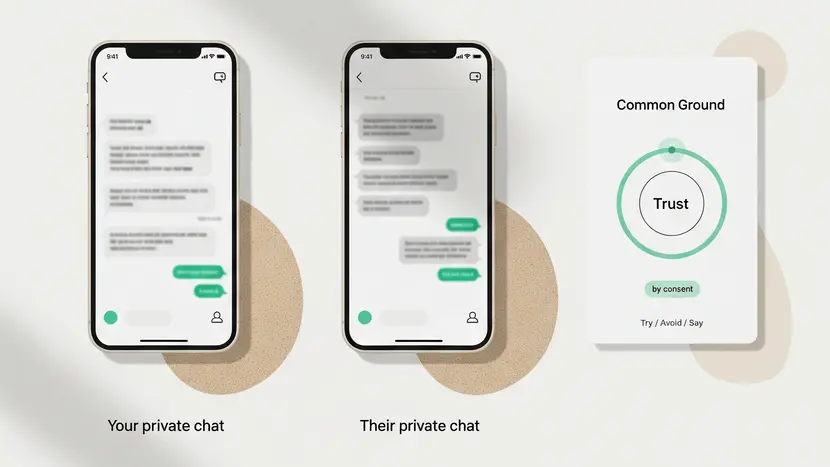
LoveFix is built for exactly this: the conversation where one of you has stopped feeling heard and neither of you can find the way in. Each of you works through it privately with Sage, an AI coach rather than a therapist, and you both come away with the same shared summary. You can start free.
You’ve probably already said the important thing. Said it more than once, in more than one way.
What’s left isn’t better words. It’s someone on the other side willing to be changed by them.