Why the technique you learned calm is unavailable hot, and what changes a conversation instead
You read the article. You did the thing.
You said “I feel” instead of “you always.” You picked a quiet evening. You asked whether it was a good time to talk.
Ninety seconds in, you were both somewhere else entirely. A voice went up. The old sentence came out. Somebody said “forget it” and started loading the dishwasher.
You are not short of techniques. You could teach the techniques. Your phone is full of saved posts about active listening and open questions and never going to bed angry.
None of it was available to you at twenty to nine on a Tuesday, standing in a kitchen, with your heart going.
If that gap is familiar, the problem is not that you lack communication skills. It is that skills are the last thing to arrive and the first thing to leave.
What better communication in a relationship actually is
Better communication in a relationship is the ability to stay in contact with someone while you are upset with them.
Not a set of phrases. That is the whole skill. Everything else is packaging.
Two people can trade perfectly constructed sentences and end the night further apart. Two others can say clumsy, half-finished things and end it closer. The difference is not vocabulary. It is whether either of you stayed reachable while it hurt.
Which is why the tips test so badly at home. They describe how a couple who already feel safe with each other sound. They do not produce the safety.
An “I feel” sentence from someone who is not braced is a bridge. The same sentence from someone expecting an attack is a legal document, and your partner can hear which one it is before the third word.
Why communication advice fails at the exact moment you need it
Communication advice fails under pressure because it is learned in one nervous system state and needed in another.
Gottman uses the word flooding for what happens to you next. Heart rate climbs. Hearing narrows. The capacity to take in anything new drops away.
Flooded, you are not a worse communicator. You are a different animal. The part of you that remembers the technique has gone offline, and what is left is fast, defensive, and very sure it is right.
A technique learned calm is unavailable hot. That is not a character failure. It is how bodies work.
So the sequence most advice recommends is backwards. It asks you to perform a skill during the exact minutes in which you cannot reach it, then hands you the failure as evidence you did not want it enough.
Couples who look like good communicators are rarely doing something clever mid-fight. They are doing something before it and something after it.
Communicating to be understood, and communicating to win
Every hard conversation is really two conversations, and only one of them is about the topic.
In the first, you are trying to be understood. Success looks like your partner knowing something about your inside that they did not know an hour ago. You can get there and still not get your way.
In the second, you are trying to win. Success looks like an admission. Success looks like them agreeing that your version of Saturday is the accurate one.
You cannot run both at once, and most of us switch from the first to the second without noticing. The tell is small. You start gathering evidence. You bring up the other time. You feel a flicker of pleasure when they cannot answer. That is the switch.
Marshall Rosenberg, who developed nonviolent communication, separated observation from evaluation for exactly this reason. “You left the plates out” is an observation. “You never think about anybody but yourself” is a verdict, and verdicts start trials.
A trial needs a defendant. Nobody has ever felt close to somebody while being cross-examined. If your conversations reliably turn into cases being argued, You’re Not Fighting About What You Think You’re Fighting About maps what the argument is standing in for.
Most couples do not have a communication problem
Most couples communicate clearly enough, and the trouble is that what gets through is unwelcome rather than unclear.
Watch two people who say they cannot communicate. She knows exactly what he means by the pause before he answers. He knows exactly what she means by “it’s fine.” The signal is arriving perfectly. What is broken is what happens in the four seconds after it lands.
Gottman’s term for the catch is a repair attempt, meaning anything either of you does to stop the negativity escalating. A joke at the right second. A hand on a shoulder. “Can we start that again.” Small moves. Offered early.
The couples who describe their communication as good are usually not the ones who never say the wrong thing. They are the ones who catch it early. Couples who describe themselves as having a communication problem tend to have a full inventory of bad exchanges and no working method for ending one.
That is a repair problem wearing a communication problem’s clothes. If your attempts to de-escalate keep bouncing off, The Art of the Repair Attempt covers why timing and tone decide whether they land.
Communication habits that quietly make it worse
Some of the most recommended communication habits do damage when the people using them are already braced.
The scheduled talk. “We need to sit down this weekend” gives your partner three days to build a defense. By Saturday they are not in a conversation, they are at a hearing.
The I statement with a verdict inside it. “I feel like you are a selfish person” is an accusation in costume. The grammar is correct and the content is a charge.
Repeating it back. Paraphrasing proves receipt. It does not prove the thing mattered. Delivered without warmth it reads as procedure, and procedure is what people do instead of caring.
Total honesty. Saying every true thing you feel is not communication, it is unloading. Some true things are only true for an hour.
Explaining more. When you are not being understood, volume and detail feel like the obvious answer. They are also the reason the same argument has been running for four years. How to Stop Having the Same Fight Over and Over has the map for that loop.
What actually changes the way two people talk
Three things change how a couple talks to each other, and none of them is a phrase.
Lower the temperature before you touch the content. Nothing useful gets said above a certain level of arousal. Twenty minutes apart doing something genuinely absorbing does more than any script. Not stewing. Actually elsewhere.
Shrink the unit. Say the small thing in the week it happens, while it is still small enough to be said badly without consequence. Couples who seem to communicate easily are often just current, with no backlog. Ordinary daily contact is what keeps the backlog from forming, which is the real point of 15 Micro-Connections That Strengthen Your Relationship.
Make the return cheap. Most couples have no agreed way back into a conversation they abandoned, so the abandoned ones stay abandoned. Build one sentence you both accept without argument. “I want to come back to last night.” The sentence matters less than the fact that it was agreed in advance, because pre-agreed things survive flooding and improvised ones do not.
Communication improves in the calm. The storm is only where you find out what you built.
How to communicate better in a relationship when you are already hot
When you are already flooded, the only good communication move is to stop communicating and say so.
Not walking out. Walking out is a punishment and it lands as one. The difference between a break and an abandonment is whether you named a return.
“I want to keep talking about this and I have stopped being any use. Give me twenty minutes.”
Then take twenty actual minutes, and come back at the end of them. A break you do not return from teaches your partner never to agree to one again.
If your partner is the one who has gone hard and short and impossible, they are almost certainly not attacking you. They are protecting something. Why Your Partner Gets Defensive covers what sits underneath that and how to lower it.
And if the conversation has already blown up, the hour afterwards matters more than anything either of you said during it. What to Do in the First Hour After a Fight is about that window.
What you are really asking for when you ask to talk
Underneath almost every request to talk sits a question that has nothing to do with the topic.
Am I still someone you take seriously. Do I still land on you. Would you notice if I went quiet.
The dishwasher is the dishwasher, and it is also the delivery mechanism for that question. Which is why solving the surface issue so often changes nothing, and why an answer to the real question can end an argument that the surface facts do not support ending.
Say the question, not the evidence for it. “I have been feeling like I am somewhere near the bottom of your list this month” is much harder to say than a list of the times they were late. It is also the only one of the two that can be answered.
When better communication is not the answer
Better communication is the wrong goal when what is happening in the house is not a misunderstanding.
Contempt is not a communication style, it is a verdict already reached. Ongoing betrayal is not a communication issue. Neither is an arrangement in which one person’s requests are always the unreasonable ones.
Two people talking better will not make an unfair arrangement fair. Some conversations go badly because they are about something genuinely unresolved. Wording will not touch it.
Where there is fear, coercion or any risk of harm, this is not the right frame at all, and a professional who can see your specific situation is worth more than any article. A couples therapist is also the right call when you have both tried in good faith for a long time and still cannot get out of the loop on your own.
Quick reference: how to communicate better in a relationship
What is usually broken: Not the sending. What happens in the seconds after a message lands badly.
What does not work:
- Scheduling a serious talk days in advance
- An I statement used to deliver a verdict
- Paraphrasing without warmth
- Saying every true thing you feel
- Explaining the same point louder
What helps:
- Lower the arousal before you touch the content
- Say the small thing the week it happens
- Agree one sentence for restarting a conversation
- Name a break, give it a length, come back
- Answer the question underneath the topic
When to get outside help: Contempt in ordinary speech, a loop neither of you can exit, or any fear in the room.
The next conversation
Nobody communicates well on the strength of technique alone.
What actually carries a conversation is plainer than that. Enough regulation to stay in the room. Enough practice to know the way back in. Enough goodwill in the bank that a badly worded sentence gets read generously instead of filed.
All of that is built in ordinary hours, not in the argument. The argument only shows you the balance.
If the same conversation keeps failing, the next step is not a better sentence. It is having it somewhere you are not already braced.
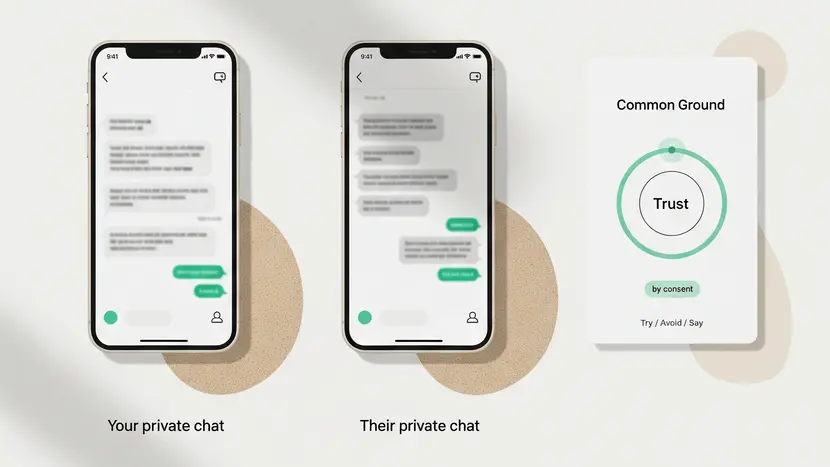
LoveFix was made for that kind of conversation. Each of you works through it privately with Sage, an AI coach rather than a therapist, and you both come away with the same shared summary. What you say in your private conversation is never shown to your partner. One subscription covers both of you, and you can start free.
You will not talk your way out of every hard thing. But most couples are not failing at communication. They are two tired people who ran out of ways back to each other, and ways back can be built.